Energy Stuff - Solar Systems, Solar System Repairs, New Systems, Upgrades & Monitoring

Living off-the-grid – the realities

Living off-the-grid – the realities

Written by Daniel Pedersen / The Land / 29 May 2018

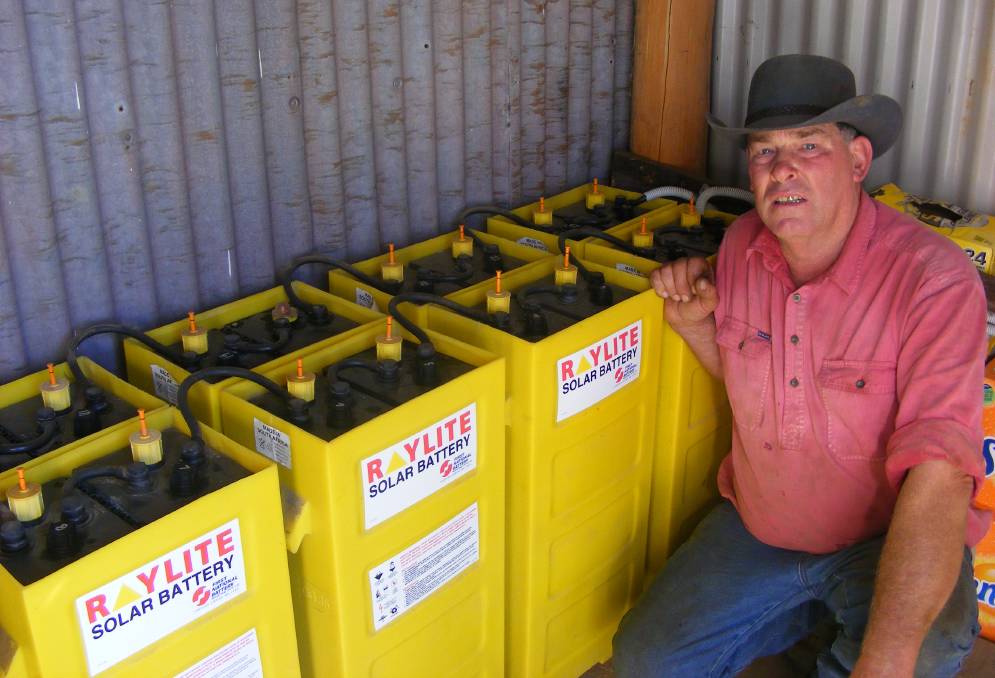
WHEN Jeff and Marg Foster took on the 160-hectare “Bendee” outside of Bingara in 2011 it was a no-brainer when it came to operating independent of the national energy grid.

It was going to cost $100,000 to connect to the grid, what with the costs of poles, wires and contractors, compared with $55,000 for a stand-alone solar system.

“We basically had three options, spend the money to connect to the grid, a big diesel generator or solar,” said Mr Foster.

“Our trouble was that it’s expensive to get on the grid, and it’s not like you then get the electricity for free,” he said, “it’s still got to be paid for”.

A few quick calculations and Mr Foster reckoned on today’s retail electricity rates he’d be paying about $7.20 a day or between $2500 and $2700 annually for power.

“And that’s a small use rate, if you’re running pumps to water stock you could quite feasibly double that,” he said. The power unit on “Bendee” runs the household and a significant workshed, which includes a welder, a bench grinder and the usual selection of power tools.

We basically had three options, spend the money to connect to the grid, a big diesel generator or solar.– Jeff Foster

Mrs and Mrs Foster have been running off grid for seven years now and are extremely happy with the system.

Mr Foster has never once been on the roof to maintain the solar panels. They do have to be careful not to overload the system, for instance running the welder and the kettle at the same time, which both draw large amounts of power instantaneously.

He said off-grid was certainly being pushed as the way to go, but added, as was often the case, there was a dark side to the equation.

“For people who can’t afford standalone power, or are limited by their rooftop – say they live in a block of 80 units in Sydney – mains power is going to become more expensive,” said Mr Foster.

“The more people who go to standalone power will mean the costs of maintaining the grid will be borne by fewer people.

“If 20 per cent of customers dropped off-the-grid tomorrow, costs could double for the remainder.”

He said there would probably come a time when all roofing was photo-voltaic.

Marg laughs when she talks about how little some people know solar. “We still get people asking us: ‘Yes, but what do you do of a night-time?”’


Energy Stuff Off Grid specialises in off-grid systems for homes, farms, batches and sheds. We sell a range of DIY battery systems right through to fully customised systems for houses, farms and small businesses. We have a specialist team that works in this area with over 5-years’ experience. Call us on 1300 656 205 or visit our website https://offgridaustralia.com.au/  

Making Off-Grid Living Easy

CUSTOM DESIGN, LOCALLY INSTALLED
We have the right end-to-end solutions. Off-Grid Energy Stuff is proud to work with CEC Accredited Off-the-Grid specialists across Australia for all of our installations. By using local installers we can also provide ongoing service and backup to ensure your system is maintained and quickly put back into service if you ever have a fault.

BEAT EXPENSIVE GRID CONNECTION CHARGES
If you live in a remote location and are moving into an existing house, adding a removable house or building a new house, then off-grid solar systems can be cheaper than paying large setup costs connecting to the grid. So, if you don’t have access to the national grid for electricity, our range of high quality off-grid solar systems are the perfect option as a complete stand-alone power system.

Experts in complete off-grid solar system packages & off-the-grid power solutions. We are the largest provider of off-grid solar systems for Australians looking for stand alone solar energy, no matter where you live we can help with our Australia-wide delivery and complete off-grid solar and battery installation service. If you live in a remote location and are moving into an existing house, adding a removable house or building a new house, then off-grid solar systems can be cheaper than paying large setup costs connecting to the grid. We have portable kits and we can customise systems to suit all needs.

The Importance of Testimonials for Energy Stuff Off-Grid

The Importance of Testimonials

Selecting your Off-Grid Solar Provider can be slightly daunting. Testimonials are an extremely important part of the success of our business. We are focused on not a sale, but razor focused on our customers being part of a long term relationship and journey. Every Energy Stuff customer is sent an anonymous survey after each install. We are serious about gathering the true picture of how our customer service team, design team and installation team went during our customers journey to lower energy bills or true energy independence. Living off-the-grid and being in remote locations, provides additional challenges for the Off Grid Energy Australia team. Items such as transport, install team availability and schedules, not even mentioning the weather and home builders temperaments, all throw potentially project delaying elements into even the best of project plans. Having an all in “team approach” and the passion for exceptional customer service, help us grow our business by way of solid word of mouth referrals.


Here is what Peter noted in his feedback form;

The whole process from start to finish has been painless. Goran did an excellent job designing the system and walking me through what would be the need and any pitfalls. Richard who managed the project did an excellent job of sorting out the minor hiccup on the delivery of the first set of solar panels that went astray, I enjoyed dealing with him. He “always answered his mobile” and was ready to sort any problems, he was also very patient when things didn’t go, according to plan, I was very impressed.

The installer was professional and did an excellent job on the installation, including walking me through all the bits and pieces.

Overall, I feel I made a great choice in choosing Energy Stuff as my Off-Grid Solar Provider, and would not hesitate in recommending them to other people who are looking at going down this path.

Great job guys, many thanks, a truly Professional Company.

Peter – Victoria


Description.

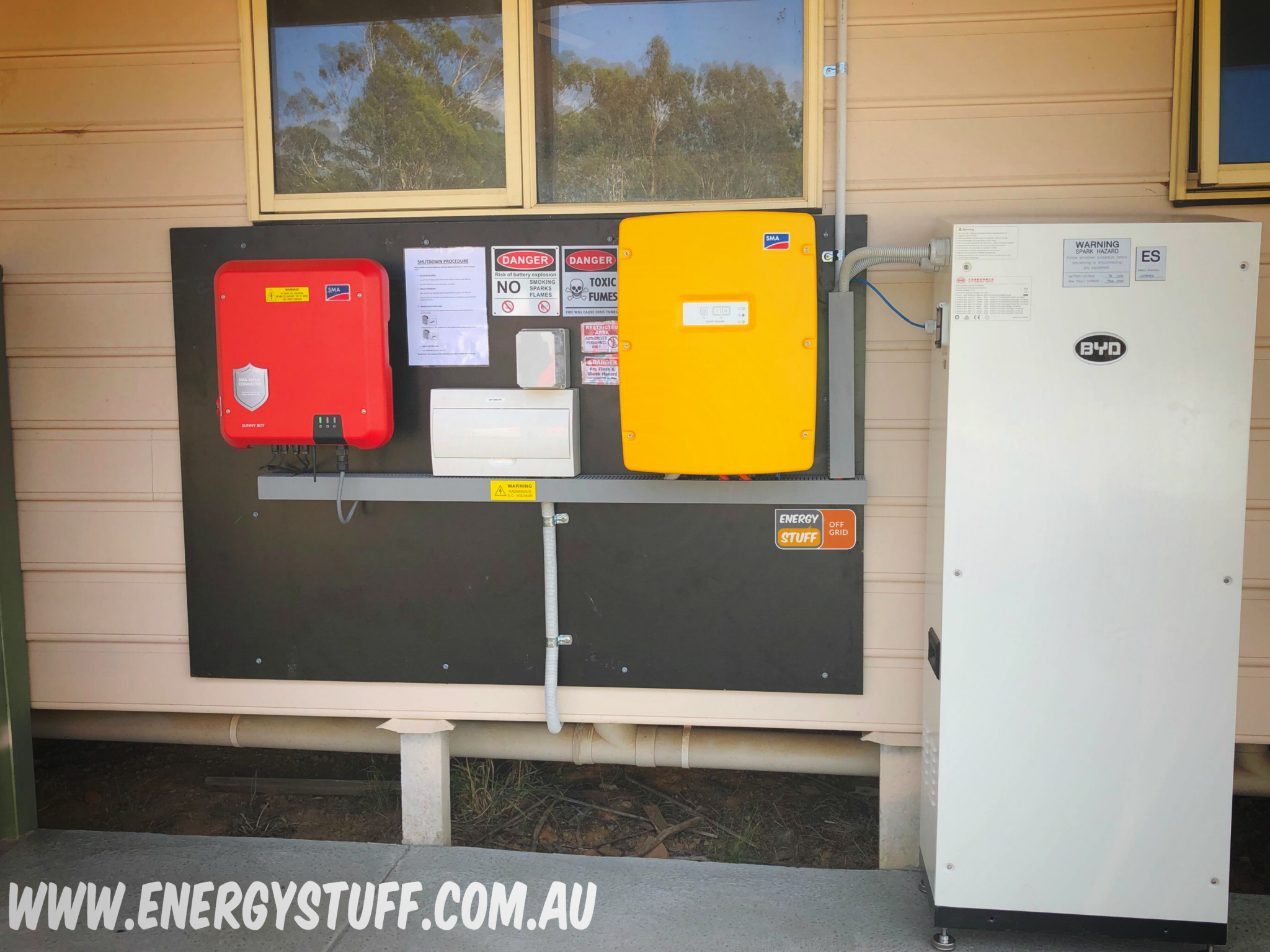
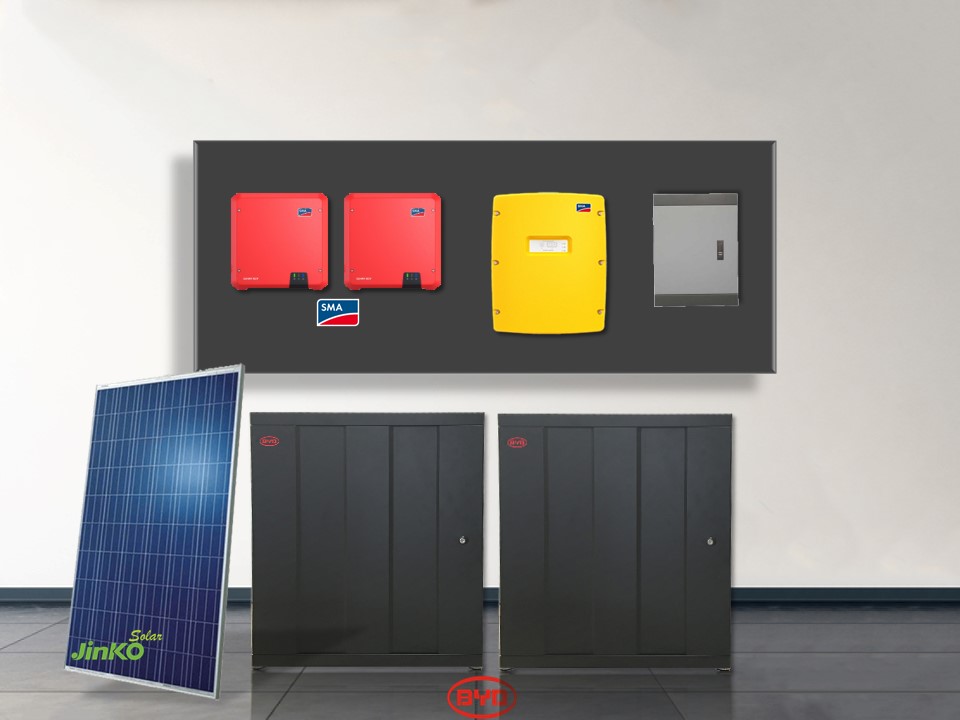
Complete Off-Grid system with the latest proven lithium battery technology from BYD and German SMA inverters.

These AC coupled systems are very efficient for powering higher loads during the day such as air-conditioning, pool pumps, washing machine, dryer, heat pumps etc.

When correct sized you can during daytime live a normal life like you are connected to the grid and the large capacity from the two inverters allows more simultaneously use of appliances.

Upgradable in the future if required.

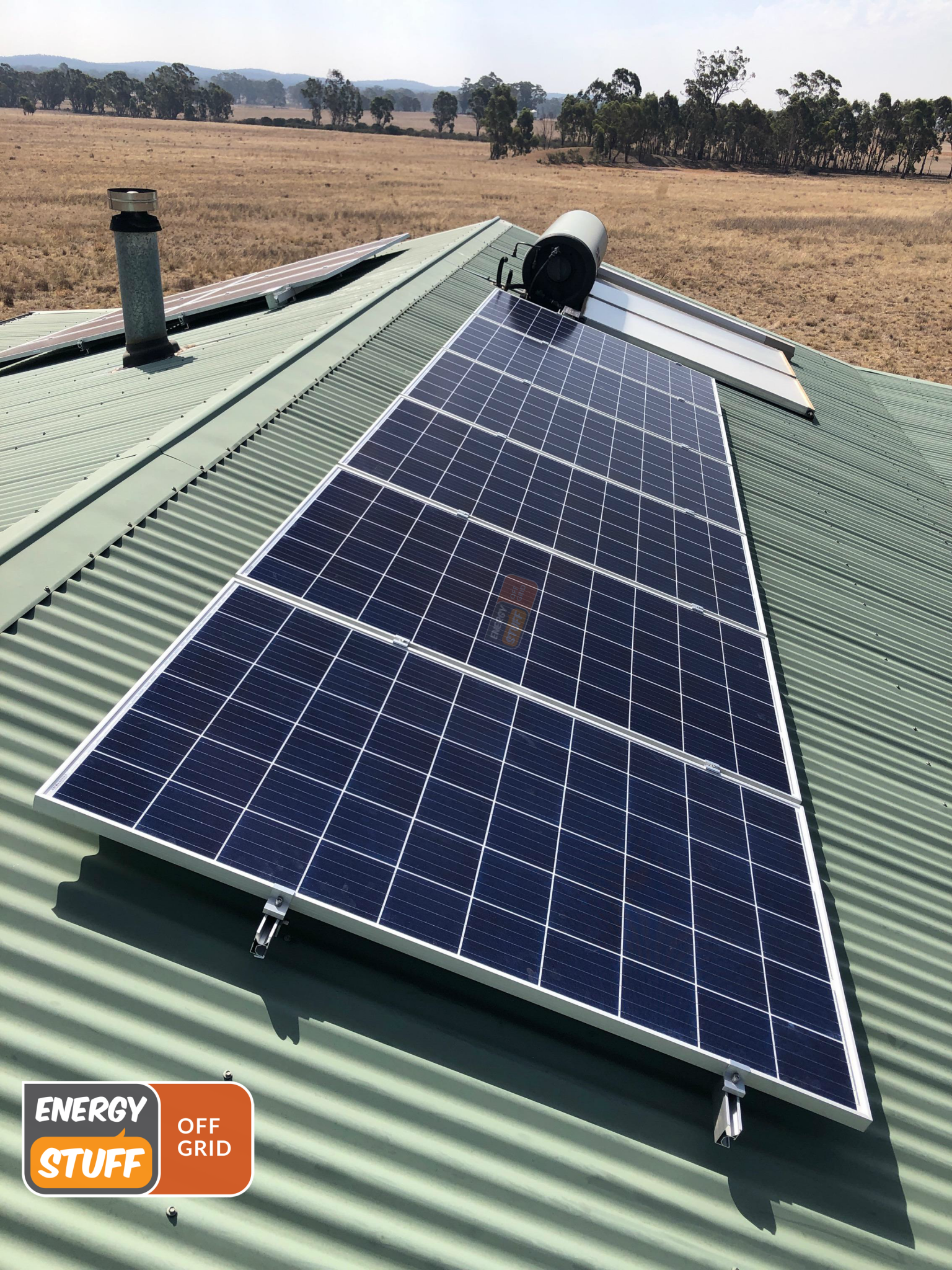
Peter’s Off-Grid system:

3.3kW Tier 1 solar panels from Jinko

SMA Sunny Boy 5kW panel inverter/solar regulator

SMA Sunny Boy 4.4kW Off-Grid/Battery inverter

7.5kWh BYD B-Box LV modules

Back-up generator connected to the system

If your considering going off the grid, or planning to build in a remote location, please down load our free “Guide to Off grid Living ” now.


Our Locations

Our Head Office & Warehouse is located at 25A Lobelia Drive, Altona North VIC 3025 and our Off-Grid team are located at 14-20 Aerodrome Rd, Maroochydore QLD 4558. All our installation crews across Australia are ready to check your warranty, support, inspect, check and upgrade your existing or faulty equipment.

Call 1300 656 205.

Ambitious energy efficiency targets needed

Posted by EcoGeneration / 23 January 2019 

Victoria’s opportunity

We’ve put the challenge to the Victorian Government to continue to strengthen its energy savings  scheme by converting from an emissions reduction target to a percentage of electricity and gas sales from 2021 with a progressive increase to 10% of electricity and gas consumption by 2030.

This would be an increase from the current 2020 target of 6.5 million tonnes of carbon dioxide emissions avoided which is estimated to equate to approximately 6.2% of electricity and gas consumption.

The Victorian Energy Upgrades (VEU) program is the most significant policy driver for energy efficiency in Victoria. A review to determine VEU targets to be set from 2021-2025 commenced on October 15, 2018, with a target scheduled to be announced in March 2020 by the Department of Environment, Land, Water and Planning.

The Energy Savings Industry Association (ESIA) has requested that the announcement date be brought forward to Sept 2019 to allow time for industry to transition so momentum of energy upgrades can be maintained.

Conversion of the target from greenhouse gas emissions to an energy metric is recommended as:

  • emissions intensity of electricity consumption can vary considerably from year to year and can be dependent upon the levels of imports and exports from other jurisdictions. This makes planning for new investment more difficult.
  • consumers will be able to more easily relate upgrades to saving energy and lowering energy bills.

The ESIA recommends that megawatt hours (MWh) be used as the metric as it is more commonly used and readily understood by stakeholders than gigajoules (GJ).

The 10% target recommended by the ESIA is based upon increasing the target at the same rate during the 2021 to 2030 period as for the 2016 to 2020 period and using facts and assumptions provided in Table 1.

To date, the VEU has been tracking well ahead of targets for 2016 to 2020, which is a positive indication for continuing the target increase trajectory. The ESIA advocates that this is readily achievable given the other measures and changes that we have recommended to improve the operation of the scheme.

The VEU target for 2020 of 6.5 million tonnes CO2-e converted to 5,936GWh is equivalent to 6.2% of total energy consumption. It is assumed that this amount would increase on a linear basis to arrive at 10% of total energy consumption by 2030. Actual energy consumption will be lower than baseline energy consumption due to activities installed under the VEU.

Proposed VEU target: 10% by 2030 – trajectory in GWh equiv. The target would increase from 4,932 GWh in 2016 to 8,821 GWh in 2030, the latter factoring in a reduction in baseline energy consumption as explained above.

Post code analysis of upgrades

The ESIA commissioned analysis of the level of uptake of various types of energy-savings upgrades directly attributable to the VEU since its inception in 2009 to 31 December 2017. It was determined using very conservative parameters that on average 1.5 upgrades per dwelling have occurred across the state.

Uptake averages have been comparable between metropolitan and regional areas, with slightly higher uptake in areas with average lower incomes in comparison to higher average income postcodes.

It could be assumed that lower-than-average uptake in various inner-city areas could be due to barriers such as rental properties (tenants don’t tend to do upgrades) and older

housing stock. Whereas a slight increase in outer suburbs could be due to significantly more opportunity for upgrades of larger homes with for example, many more downlights and other appliances due to larger land and building sizes.

Key high efficiency upgrade types have included:

  • for businesses: commercial lighting, refrigeration display cabinets and fan motor upgrades; and
  • for households: high efficiency pool pumps, lighting, destruction of pre-1996 fridges and freezers and upgrades, clothes dryers and televisions.

While statistics from the Victorian Government and separately from the ESIA estimate average annual bill savings of a participating household to be around $150-175, households that have undertaken multiple upgrades will be saving much more. For example, according to ESIA research: per year a pool pump upgrade can save $225, a high efficiency clothes dryer $110, removing a pre-1996 fridge of freezer $125, upgrading lighting $160 and a television could save $27.

NSW ambition

The NSW Government has a 16,000GWh energy savings target to 2020 which overarches its Energy Savings Scheme (ESS) that has its own annual targets which are currently 8.5% of electricity sales from 2019-2025. The 16,000GWh energy savings target includes a suite of measures including NSW Climate Change Fund programs, the ESS, building standards and initiatives and Commonwealth programs.

This illustration of the NSW approach shows at a glance the suite of energy-saving initiatives being measured in that state. In this scenario published in 2016, the ESS would be the third largest contributor by 2020. Current actual figures may reflect that the ESS is delivering a larger portion of actual energy savings, given that the scheme has exceeded its target comfortably by 10 to 15% since 2017, based on analysis by Green Energy Markets to the end of November 2018.

The latest ESS Annual Report for 2017 published in 2018 by the NSW Independent Pricing and Regulatory Tribunal (IPART) stated that since the ESS commenced in July 2009, a total of 23,776,877 certificates that have been created for activities implemented under the scheme represent 22,363,865MWh of electricity savings and 176,780 MWh of gas savings.

In 2015, the NSW Government strengthened its ESS by: expanding the program to include gas savings; supporting energy savings made by regional customers; and extending the scheme to 2025 and increasing the targets incrementally from 5% in 2015 to 7% in 2016, 8% in 2018 and 8.5 % from 2019-2025.

Nationwide opportunities

The ESIA continues to advocate for a National Energy Savings Scheme (NESS) by 2025 which would complement existing schemes in Victoria, NSW, South Australia and the Australian Capital Territory and any others that may be established in the meantime.

A NESS could provide incentives for upgrade activity types that may not be available through various existing schemes, and would enable all households and businesses across Australia to participate, which is obviously currently not possible at the moment for Queenslanders, West Australians, Northern Territorians and Tasmanians.

There is an opportunity to further adapt the Commonwealth Government’s Emissions Reduction Fund (ERF) to enable more energy efficiency projects to be implemented through that mechanism, using methodologies proven in the existing energy savings schemes. However, the ERF is reliant upon the provision of funds for projects (and most of that has been committed), whereas a NESS would have no net cost to government.

There is already a lot of work going on in the background between the various governments and industry to ‘harmonise’ these schemes. For example, both SA and the ACT use the approved product registry established by NSW, and methodologies for calculating energy savings of particular types of energy upgrade are periodically being adjusted and shared for consideration between scheme administrators in each jurisdiction. This harmonising process continually sharpens the opportunity for industry to innovate more efficient products that can be marketed across Australia, and for governments to reduce ‘ red tape’ which can stymy roll outs unnecessarily.

Case Studies – Energy Upgrades

A greater scale of innovation, job creation and skill-building can be stimulated in the energy savings industry in Australia in lighting, air conditioning and insulation technologies to name a few. Commercial building management system upgrades can revolutionise building efficiency ratings (like NABERS) and industry boilers, gas burners and electric motors present major energy-saving opportunities. An energy efficiency upgrade is the logical leading partner of any renewable energy upgrade.

Hamish McGovern is the president of ESIA and managing director of Wattly. With thanks to ESIA members for contributions to this article.


Energy Stuff specialises in Residential Solar with emphasis on Repairs, Replacements and upgrades. We also provide new systems, battery storage, Off-Grid systems and smart monitoring systems so call us if we can be of support 1300 656 205 or go to our website at http://www.energystuff.com.au

Victoria solar rebate notches up nearly 7,000 new rooftop systems

By Sophie Vorrath / One Step Off The Grid / 22 January 2019

Victorian households are cashing on the state government’s solar homes rebate by the thousands, with latest reports indicating nearly 7, rooftop PV systems have been installed under the $1.2 billion scheme since its launched in late August last year.

State energy minister Lily D’Ambrosio said on Friday that around 1,600 households had already received a rebate for their rooftop solar systems, with many more installations underway.

Hotspots in the state include the outer western Melbourne suburb of Tarneit, where a whopping 212 systems are being installed,  followed by Clyde North (161), Craigieburn (131), Truganina (123) and Cranbourne East (98).

As we have the reported, the hugely popular policy provides up to $2,225 towards the installation of solar panels – roughly half the cost of a 4kW PV system.

From July this year, the other half of that cost will be able to be covered with a four-year interest-free loan, but only households who buy solar panels before July will be eligible for the rebate, too.

The subsidy’s popularity bodes well for the separate home battery subsidy, which was announced in September of last year, just weeks before the Andrews government secured another term with a crushing victory at the state poll.

Under that scheme, the government will provide $40 million for subsidies for up to 10,000 homes, based on the size of the battery. Some households will get up to $4,838.

“We promised to put power back in the hands of Victorians and that’s exactly what we’re doing – helping people take control of their energy costs and make a real difference to the state’s long-term energy future.”

“Our Solar Homes program has already proved to be tremendously popular and is helping Victorians to save hundreds of dollars a year on their energy bills.”

“We’re also expanding the Solar Homes to include rental properties, hot water systems and battery installations – giving Victorians a fair go and helping the environment.”


Energy Stuff provides a full range of new solar systems which can include battery ready inverters or systems with integrated battery storage. We also provide smart energy management systems which will continue to deliver energy saving benefits into the future. We only use CEC accredited installers and we fully comply with the Victorian Govt. Solar Rebate Program. Finance can be arranged for as little as $2.96 a day. For further information call 1300 656 205 or go to our website at https://offgridaustralia.com.au/new-solar-system/


Victorian Registered Electrical Contractor Licence # 27787

City of Melbourne hits 100% renewables as 80MW wind farm comes online

By Sophie Vorrath / One Step Off The Grid / 18 January 2019 

The City of Melbourne has set a high bar for governments around the country, kicking off 2019 with the news that 100 per cent of the its operations are now powered by 100 per cent renewable energy – an Australian first.

“We are immensely proud to be the first Australian capital city council powered by 100 per cent renewable energy,” said Deputy Lord Mayor Arron Wood in a statement.

“Every light on our streets, every treadmill in our gyms and every barbecue in our parks is now powered by renewable energy,”

Image: Deputy Lord Mayor of Melbourne Arron Wood. Source: Twitter

The council’s success was driven by the Melbourne-led bulk buy renewables project, built around a consortium of 14 of leading local universities, cultural institutions, corporations and Councils.

The ground-breaking Melbourne Renewable Energy Project (MREP) paved the way for development of Pacific Hydro’s 80MW Crowlands Wind Farm, near Ararat.

The project was underpinned by a unique group purchasing model that contracts the 14 consortium members to buy a total of 88GWh, or one-third of the assumed output of the wind farm, at an undisclosed price.

The MREP partners include the University of Melbourne, RMIT, Federation Square, City of Port Phillip, City of Yarra, Moreland City Council, Bank Australia, Zoos Victoria, Citywide, National Australia Bank, Australia Post, Melbourne Convention and Exhibition Centre and NEXTDC.

Construction began on Crowlands in May of last year, and this week, according to Wood, was nearing completion, with 25 of the 39 turbines fully installed and energy flowing into the power grid.

That progress has in turn taken the City to 100% renewables, topping up previous efforts in energy efficiency and rooftop solar installs.

“Making the move to 100 per cent renewable energy is the ultimate New Year’s resolution,” Wood said.

“We were also the first group in this country to implement a renewable energy power purchasing agreement.

“We have led the nation in responding to climate change, securing a sustainable energy supply for the future and have shown a great example of how a major city with a $92 billion economy can influence positive outcomes in our regional towns.”

Wood said that construction of the Crowlands wind farm – which had created more than 140 regional jobs, and eight ongoing maintenance jobs – was ongoing and on target to be fully completed in May.

And there are more plans for MREP, too.

“Leading by example, we will expand the ground-breaking project to facilitate power purchase agreements for businesses across the city,” Wood said.

“This will continue to generate investment in new renewable energy which is the cheapest cost for new build electricity generation. So it’s good for the environment, great for the economy with new jobs and really good for the hip pocket to manage energy costs into the future.”


Energy Stuff provides a full range of new solar systems which can include battery ready inverters or systems with integrated battery storage. We also provide smart energy management systems which will continue to deliver energy saving benefits into the future. We only use CEC accredited installers and we fully comply with the Victorian Govt. Solar Rebate Program. Finance can be arranged for as little as $2.96 a day. For further information call 1300 656 205 or go to our website at https://offgridaustralia.com.au/new-solar-system/


Victorian Registered Electrical Contractor Licence # 27787

SolarEdge teams with Google to integrate automated EV Charging

By Joshua S Hill / RenewEconomy / 14 January 2019

Israeli-based solar manufacturer SolarEdge announced last week that it was teaming up with Google to integrate Google Assistant into its own electric-vehicle charging solar inverter, only days after it announced the acquisition of Italian e-mobility company S.M.R.E Spa.

Announced during the mammoth Consumer Electronic Show (CES) held at the Las Vegas Convention Center last week, integrating Google Assistant into SolarEdge’s EV-charging solar inverter – the first of its kind – means that consumers can now tell their Google Assistant to start and stop charging of their electric vehicle.

The news came as Google announced a whole range of new devices that their Assistant now works with, and also includes eMotorWerks’ home EV charging station, the JuiceBox Level 2 (in addition to irrigation services, new devices and appliances, and McAfee’s Secure Home Platform).

“Smart homes have mainly been about convenience and interconnectivity, but the next step of the smart home is integrating smart energy management, such as EV charging,” said Lior Handelsman, SolarEdge’s Founder and VP of Marketing and Product Strategy.

“By merging the simplicity of smart homes with the value of smart energy through this collaboration with Google, SolarEdge is leading the way in making the power of smart solar energy more accessible to more people”

SolarEdge is the first company to introduce an electric-vehicle charging inverter which enables consumers to directly charge their electric vehicles with electricity generated by their rooftop solar panels.

The EV charging inverter also allows customers to charge their vehicles up to 2.5 times faster than a standard EV charger through a simultaneous combination of grid and PV electricity.

The news came two days after SolarEdge announced that it was entering the e-mobility market with its acquisition of S.M.R.E Spa (SMRE), an Italian company boasting three business units – e-mobility, automated production machine, and telematics software.

SMRE was formed in 1999 and has over 15 years of experience developing end-to-end e-mobility solutions – such as high-performance powertrains with e-mobtor, motor drive, gearbox, battery, BMS, chargers, Vehicle Control Unit (VCU) and software for electric vehicles – for electric and hybrid vehicles such as motorcycles, commercial vehicles, and trucks.

SolarEdge will purchase acquire 51 per cent of the company by acquiring outstanding shares currently held by the founder and two additional stockholders for a investment totalling around $77 million – with half to be paid in cash and the other half to be paid in shares of SolarEdge common stock – with the transaction to be closed in the coming weeks.

This will be followed by a mandatory tender offer in which SolarEdge will offer to purchase the remaining outstanding SMRE shares in an all cash transation.

The acquisition by SolarEdge makes sense considering that, with governments and automotive manufacturers around the world committing themselves to the electrification of transportation, the electric vehicle industry is expected increase from around 1 million electric vehicles in 2018 to around 20 million being produced and bought each year in 2030.

“The acquisition of SMRE is another step in executing our strategy of sustainable growth by addressing an additional fast growing and technologically synergetic market while diversifying into new fields outside the solar arena,” explained Guy Sella, CEO, Chairman and Founder of SolarEdge.

“SMRE’s innovative technology and experienced, successful team provides SolarEdge with fast-track access to the high-growth e-mobility market. We believe that combining SMRE’s vast experience and full powertrain technology with SolarEdge’s innovative power and battery technology, proven operational excellence and global reach, positions us to become a market leader in this important market.”

“SMRE built a strong team that has developed products addressing the current and future needs of the e-mobility market,” added Samuele Mazzini, CEO, Chairman and Founder of SMRE.

“SMRE’s expertise together with SolarEdge’s successful business track record, R&D capabilities and innovative power electronics will favorably position us in the global transition to e-mobility.”


Energy Stuff provides a full range of new solar systems which can include battery ready inverters or systems with integrated battery storage. We also provide smart energy management systems which will continue to deliver energy saving benefits into the future. We only use CEC accredited installers and we fully comply with the Victorian Govt. Solar Rebate Program. Finance can be arranged for as little as $2.96 a day. For further information call 1300 656 205 or go to our website at https://offgridaustralia.com.au/new-solar-system/


Victorian Registered Electrical Contractor Licence # 27787

Waste crisis looms as thousands of solar panels reach end of life

Main image: Australians have embraced the rooftop solar revolution, but critics say governments are lagging on managing the waste. CREDIT: JUSTIN MCMANUS

By Nicole Hasham / The Sydney Morning Herald / 13 January 2019

Thousands of ageing rooftop solar panels represent a toxic time-bomb and major economic waste unless Australia acts swiftly to keep them out of landfill, conservationists and recyclers say.

Australia’s enthusiastic embrace of rooftop solar has brought clear environmental and economic benefits, but critics say governments have dragged their feet in addressing the looming waste crisis.

As of December more than 2 million Australian households had rooftop solar installed. The uptake continues to grow due to the technology’s falling cost and rising electricity bills.

Photovoltaic panels last about 30 years, and those installed at the turn of the millennium are nearing the end of their lives. Many have already been retired due to faults or damage during transport and installation.

The nation’s environment ministers in April last year agreed to fast-track the development of new product stewardship schemes for photovoltaic solar panels and associated batteries. Such schemes make producers and retailers take responsibility for an item across its life cycle.

However, Total Environment Centre director Jeff Angel, a former federal government adviser on product stewardship, said action was long overdue and the delay reveals a “fundamental weakness” in Australia’s waste policies.

“We’ve had a solar panel industry for years which is an important environmental initiative, and it should have been incumbent on government to act in concert with the growth of the industry so we have an environmentally responsible end-of-life strategy,” he said.

Mr Angel said photovoltaic panels contain hazardous substances and “when we are sending hundreds of thousands of e-waste items to landfill we are also creating a pollution problem”.

“It’s a systemic problem that [applies to] a whole range of products”, he said, saying schemes were badly needed for paint, batteries, floor coverings, commercial furniture and many types of electronic waste.

Photovoltaic panels are predominantly made from glass, polymer and aluminium, but may also contain potentially hazardous materials such as lead, copper and zinc.

Australian Council of Recycling chief executive Peter Schmigel attributed delays in product stewardship schemes to both “bureaucratic malaise” and unfounded concern about cost.

The national television and computer recycling scheme, which since 2011 has required manufacturers and importers to participate in industry-funded collection and recycling, showed that regulatory measures can work, he said.

“Recovery rates have been out of sight since the beginning of the scheme, nobody has said anything at all about there being an inbuilt recycling cost. It generates jobs, it generates environmental outcomes and yet for some reason we have policymakers who are hesitant about [establishing similar schemes] for solar PVs and batteries,” he said.

Victoria will ban electronic waste in landfill from July 2019, including all parts of a photovoltaic system, mirroring schemes imposed in Europe.

The Australian Council of Recycling says a national program to recycle computers and televisions has been successful and solar panels and batteries should be subject to similar schemes. CREDIT: DOMINIC O’BRIEN

Sustainability Victoria is also leading a project examining end-of-life management options for photovoltaic systems, which may progress to a national program. The issue is particularly pertinent in Victoria where a new $1.3 billion program is expected to install solar power on 700,000 homes.

Sustainability Victoria resource recovery director Matt Genever said there was strong support from industry, government and consumers for a national approach to photovoltaic product stewardship. Final options are due to be presented to environment ministers in mid-2019.

He rejected suggestions that plans were progressing too slowly.

“The analysis we’ve done in Victoria … shows that it’s in 2025 that we see a real ramp up in the waste being generated out of photovoltaic panels. I certainly don’t think we’ve missed the boat,” he said.

Solar panel components waiting for recycling at a Reclaim PV warehouse.

A report by the International Energy Agency and the International Renewable Energy Agency in 2016 found that recoverable materials from photovoltaic panel waste had a potential value of nearly $US15 billion by 2050.

Reclaim PV director Clive Fleming, whose business is believed to be the only dedicated photovoltaic recycler in Australia, said it recycles 90 per cent of materials in a panel. The company has been lobbying for state bans on solar panels entering the landfill.

The NSW Environment Protection Authority said it has commissioned research to better understand how e-waste, including solar panels, was managed. The panels can be dumped in NSW landfill, however given their life span they were “not a common item in the waste stream”, it said.

The Queensland government is developing an end-of-life scheme for batteries used in solar systems and other appliances.

A federal review of the Product Stewardship Act was expected to be completed last year, but the Department of the Environment and Energy is yet to present a report to the government.

Mr Genever hoped the review would result in a broader range of products being subject to stewardship programs and take steps to ensure voluntary schemes were effective.

Both the Smart Energy Council and the Clean Energy Council, which represent solar industry operators, said a well-designed product stewardship scheme was important and should be developed through cooperation between industry, governments and recyclers.


Energy Stuff provides a full range of new solar systems which can include battery ready inverters or systems with integrated battery storage. We also provide smart energy management systems which will continue to deliver energy saving benefits into the future. We only use CEC accredited installers and we fully comply with the Victorian Govt. Solar Rebate Program. Finance can be arranged for as little as $2.96 a day. For further information call 1300 656 205 or go to our website at https://offgridaustralia.com.au/new-solar-system/


Victorian Registered Electrical Contractor Licence # 27787

Do I, or Don’t I? the emotional and financial rollercoaster of ‘going off-grid”!


As an off-grid expert, I get asked the question constantly, “Is it a viable option?”

Well, how long is a piece of string?

I am not a fore-see-er, I do not predict the future, but what I do know is; that as long as the sun rises tomorrow, I can build you an ‘off-grid system’ that will give you the same (if not more) security and comfortability as being on grid without the monthly/quarterly power bill.

Technology has advanced so much, that nearly any demand, surge demand, constant demand is able to be accommodated for! Fishing/ hunting shacks, donga’s, live-in-sheds and temp accommodation until your home is finished. Even extravagance is NOT a limitation! ducted air cond, heated pools, heated spa’s/flooring. The ‘off-grid’ world has changed, and POWER is now literally- at our fingertips!

We now have the ability, to build to your budget, and scale up from there, or, go the whole hog! With 20-year design life on Battery power, and Solar panels that will still be providing you “FREE” power from the sun 50 years from now (a 25-year performance guarantee that YOUR panels will STILL be producing over 80% of their installed capacity after 25 years) WOW!!! Seriously, WHO gives that sort of guarantee??? (the Australian Govt.)

Every Solar PV Panel WE install has been approved by the CEC (Clean Energy Council of Australia) with a linear guarantee, that OUR panels MUST still be performing over 80% after 25 years.

Now, if that’s not enough to choose ‘Energy Stuff Off-Grid’, we ALSO only use premium German SMA inverters and regulators, combined with a scalable World Leading Battery technology, that has less than 0.03% failure rate in Australian conditions. Again…WOW!!!

Let’s take it a step further. Local installers, Australia wide, because!!! Why would you ever want to be ‘left in the dark’? We warrant our premium SMA/ BYD systems for a full 10 years for your ‘piece of mind’. (20-year design life on Batteries and the 25-year performance guarantee on Panels). I have been around a while, and I still haven’t seen an electricity provider offer these sort of warranties/ guarantees.

Anyhow, enough rambling from me, I just love what I do, and I don’t just build systems, I custom design, every job I do. I do a full profile and calculation on EVERY household. I’m a little annoying, ask a heap of questions (how many rooms, what are your appliances, how long do you run them for, what are their Watts, how many in the family, do you have gas or electric hot water, hair dryers, cookers, power tools, etc, etc, etc), and you’ll get that from our entire team of off-grid experts – because- we don’t want you as a customer, if we can’t get it right!

We are in the business of ‘off-grid solutions’ NOT maintenance solutions! No offense- but, once we have designed your system, installed it and shaken hands – we would be happy NOT to hear from you again (apart from referrals, because you are sooooo happy), or to wish us a ‘happy birthday!’.

In saying that, we have customer support and tech services available business hours AND emergency, tech support if you need it! Again, we won’t leave you in the dark-EVER!!! You’ll also be supplied with full set of papers on install. – think about it, better service already than any electricity retailer.

In all my passionate ranting, remember, off-grid electricity IS NOT for everyone! It must make financial sense. I have had customers that are 50metres away from the nearest power pole- but the pole is on the other side of a major HWY- cost to connect $315,000, others are in CBD and just want to avoid being part of ‘The Grid’, cost to connect $700. Even with the continuous power bill, it’s hard to justify this upfront expense.

Our systems are long term, and we can build ANY system for your needs, BUT, we will NOT sell you a system without a full analysis of your expected power load.

Our design calculator uses BOM (Bureau of Meteorology) and NASA data to determine the irradiance levels per M2 of your latitude, your specific postcode. Knowing the exact ‘no sun days’ over the past 20 years, helps us determine the amount of ‘days of autonomy’ (back up Battery power) required for your specific needs.

If ‘Stuff’ is worth doing, it’s worth doing right!

A greener planet, and no more power bills!  Works for me and I know it will work for you!

SOLAR REBATE PROGRAM VICTORIA – SAVE UP TO $2,225 IN REBATE

CUTTING POWER BILLS WITH SOLAR PANELS FOR 650,000 HOMES

Sunday, 19 August 2018: Breaking News: Solar Rebate Program Victoria – Saving up to $890 on electricity bills and receive up to $2,225 in rebate. 

From today, Victorians will be able to install a solar panel system and get half of the cost back via a 50 per cent rebate.

The 50 per cent rebate on solar panel systems will be available to Victorians with a household income of up to $180,000 who live in their own home valued at up to $3 million – this means almost nine out of 10 Victorians who own their own house are eligible.


“Solar Homes: 50 per cent solar rebate The Victorian Government is making solar panels more affordable than ever before, for around 24,000 eligible households. Families will only have to pay 50 per cent of the cost of a solar PV system.”


How to take advantage of the program?

Up to $2,225 in rebate. Solar power is safe and reliable and by generating your own solar power, you’ll be reducing your electricity bills.

50 per cent rebate on solar for 24,000 eligible households from 19 August 2018 to 30 June 2019. The Victorian Government is providing a 50 per cent rebate, up to the value of half of an average 4kW solar panel system (which currently equates to $2,225) for eligible households.

Victorian households are eligible to receive a Solar Homes rebate if the applicant:

  • » has a combined household income of less than $180,000 per annum before tax (based on the most recent tax assessment notices for the homeowners),
  • » is an owner-occupier of a home valued at under $3,000,000 (a copy of a recent Council rates notice will be required),
  • » the household does not already have a solar panel system installed,
  • » chooses a Clean Energy Council (CEC) Approved Product and uses a CEC Accredited Installer,
  • » has had an eligible solar panel system installed on or after 19 August 2018, and
  • » engages an installer who can provide a statement that they have not received a WorkSafe infringement notice in the past three years.

What Energy Stuff will provide to help you claim:

  • » The Commonwealth Solar PV STC Assignment
  • » The Solar Connection Form
  • » The Electrical Work Request
  • » The Certificate of Electrical Safety
  • » An invoice detailing the size, cost and date of installation of the solar PV system

Energy Stuff Pty Ltd is a fully insured and registered Electrical Contractor. Be assured, our installation, solar system equipment and paperwork all adhere to the strict requirements of this program. We were indeed very pleased to see the Victorian Premier, Daniel Andrews, consider safety when announcing this program. We have been very active over the years talking about solar safety and trying to minimise the impact on Australian home and business customers of the negative effects of such rebates and programs. It is true, in the past, many practices, such as door knocking and certain cold calling techniques have left many customers not really knowing who they are dealing with and what they have purchased.

The team at Energy Stuff are not faceless, like so many are. We proudly have our profiles on our site. Please see our team here.


Call us now on 1300 656 205 or fill in the form to the right to have us call you back.

Don’t just buy a solar system, buy a Smart Solar System.

Click on the image below to see how Smart Solar Works!


See the press release Here: https://www.premier.vic.gov.au/wp-content/uploads/2018/08/180818-Cutting-Power-Bills-With-Solar-Panels-For-650000-Homes.pdf