
Energy Stuff - Solar Systems, Solar System Repairs, New Systems, Upgrades & Monitoring

Exxon predicted in 1982 exactly how high global carbon emissions would be today

Exxon predicted in 1982 exactly how high global carbon emissions would be today

Written by Kyla Mandel / Think Progress / 14 May 2019

CO2 in the atmosphere has reached unprecedented levels.

The concentration of carbon dioxide emissions in the atmosphere reached an unprecedented level this month. Researchers at the fossil fuel giant Exxon saw it coming decades ago.

Measurements taken on May 3 at the world’s oldest measuring station, the Mauna Loa Observatory in Hawaii, recorded “humanity’s first day ever with more than 415 parts per million [ppm] CO2 in the air,” according to the United Nation’s climate change Twitter account. As of May 12, levels have remained steady at 415 ppm.

Never before in human history has there been so much carbon dioxide in the atmosphere. The last time scientists believe it may have been this high was 2.5 to 5 million years ago during the Pliocene epoch, when sea levels were 25 meters higher than today and global temperatures were warmer by 2-3 degrees Celsius.


CO2 CONCENTRATION IN THE ATMOSPHERE OVER THE PAST 800,000 YEARS ACCORDING TO ICE CORE DATA (PRE-1958) AND MAUNA LOA DATA (POST-1958). (CREDIT: SCRIPPS INSTITUTION OF OCEANOGRAPHY AT UC SAN DIEGO).

Unlike back then, however, the record carbon dioxide emissions being recorded now are the result of humans burning fossil fuels, which releases harmful heat-trapping pollution into the atmosphere. And scientists at Exxon predicted this decades ago.

According to an internal 1982 document from Exxon Research and Engineering Company — obtained by InsideClimate News as part of its 2015 investigation into what Exxon knew about the impact of fossil fuels on climate change — the company was modeling out the concentration of carbon emissions several years into the future.

According to a graph displaying the “growth of atmospheric CO2 and average global temperature increase” over time, the company expected that, by 2020, carbon dioxide in the atmosphere would reach roughly 400 to 420 ppm. This month’s measurement of 415 ppm is right within the expected curve Exxon projected under its “21st Century Study-High Growth scenario.”


IN 1982, EXXON SCIENTIST PROJECTED CARBON DIOXIDE CONCENTRATIONS IN THE ATMOSPHERE. (CREDIT: EXXON VIA INSIDE CLIMATE NEWS)

Not only did Exxon predict the rise in emissions, it also understood how severe the consequences would be.

“Considerable uncertainty also surrounds the possible impact on society of such a warming trend, should it occur,” the internal document stated. “At the low end of the predicted temperature range there could be some impact on agricultural growth and rainfall patterns which could be beneficial in some regions and detrimental in others.”

“At the high end, some scientists suggest there could be considerable adverse impact including the flooding of some coastal land masses as a result of a rise in sea level due to melting of the Antarctic ice sheet,” it continued, stating this would only take place centuries after temperatures warmed by 3 degrees Celsius.

Despite this knowledge, the company chose not to change or adapt its business model. Instead, it chose to invest heavily in disinformation campaigns that promoted climate science denial, failing to disclose its knowledge that the majority of the world’s fossil fuel reserves must remain untapped in order to avert catastrophic climate change.

The world is already experiencing the devastating impacts of climate change. As the very first line of the U.S. government’s National Climate Assessment asserts, “The impacts of climate change are already being felt in communities across the country.”

From more intense flooding, drought, heat waves, wildfires, and hurricanes, the world is becoming increasingly aware of what life in a warming world will look like. In 2018, the United States alone experienced 14 different climate and weather-related disasters, each costing over a billion dollars.

The record carbon emissions recorded this month indicate things will most likely continue to get worse; carbon remains in the atmosphere for a long time, meaning it continues to warm the world long after it is emitted. “This is a grim reminder of the perilous path we are on,” climate scientist Michael Mann said.

Mann was one of three scientists to first release what is known as the famous “hockey stick” graph in 1999. The graph, illustrating temperature increase over time, takes the shape of a hockey stick due to the sharp increase after the Industrial Revolution. Twenty years after the graph was released, CO2 levels were roughly 366 ppm. Today, Mann told ThinkProgress over email, they’re increasing by about 3 ppm each year.

“If you do the math, we’ll cross 450 ppm — which likely locks in dangerous planetary warming of more than 2C/3.5F — in just over a decade,” he said. “That means we have to act dramatically, now, to lower global carbon emissions (by about 5-10% a year) if we are to avert catastrophic climate change impacts.”

Energy Stuff specialises in Residential Solar with emphasis on Repairs, Replacements and upgrades. We also provide new systems, battery storage, Small Commercial, Off-Grid systems and smart monitoring systems. Energy Stuff only uses CEC accredited installers and we fully comply with the Victorian Govt. Solar Rebate Program.

For further information please call us on 1300 656 205 or go to our website at http://www.energystuff.com.au
W.A. to fund solar farms in six remote indigenous communities

Written by Sophie Vorrath / One Step Off The Grid / 10 May 2019

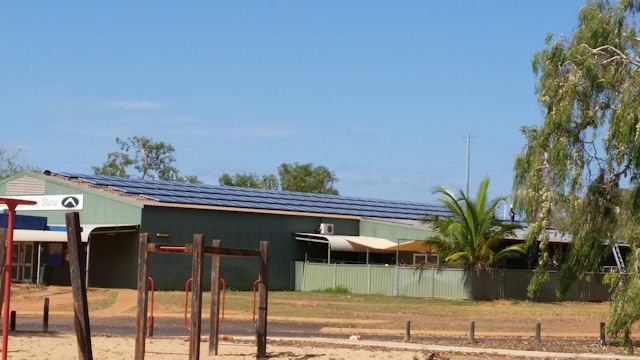
Up to 4MW of solar will be installed across six remote indigenous communities in Western Australia, as part of an $11.6 million plan to slash the use of heavy-polluting and heavily subsidised diesel fuel.

The “low-cost and reliable renewable energy solution” was announced by the Labor McGowan government as part of its budget this week, to install an average of 400-600kW in each community, starting next year.

It’s a win-win for the Labor government, considering the project will slash the cost of providing power to the 100 per cent diesel fuelled towns, while also cutting the cost of the government subsidy paid to the state-owned Horizon Power.

The program is being rolled out alongside Horizon Power’s solar incentive project which encourages eligible remote communities to invest in their own roof-top solar on community buildings, with Horizon Power contributing 30 per cent of the cost.

Energy minister Bill Johnston said the roll-out of solar farms would also foster community development through local jobs, training and investment opportunities.

State Aboriginal affairs minister Ben Wyatt – who is also state Treasurer – said it would reduce power bills for community buildings and improve energy reliability at times when it can be hard to access diesel.

The communities set to get the solar power stations are spread throughout the state’s vast Kimberley region, and the include northernmost settlement in Western Australia, Kalumburu.

The government said on Thursday that construction was scheduled for Warmun and Kalumburu in 2020 and in Ardyaloon, Beagle Bay, Djarindjin/Lombadina and Bidyadanga in 2021.

Horizon says it intends to release a Request for Tender for the construction of the east Kimberley systems in May 2019.

“The program follows on from the launch of the McGowan Government’s Energy Transformation Strategy, which aims to deliver cleaner, affordable and more reliable energy,” Johnston said.

But the W.A. Greens say the lack of funds actually allocated to driving the transition to renewables in the state budget tells a different story.

“The only commitment … made to assisting the transition to renewables is two specific solar projects,” Greens WA climate and energy spokesperson Tim Clifford said.

“And though they are important and valid projects, the spend is nothing compared to more than $41 million dollars that is just being given to the fossil fuel industry and related infrastructure.

“Rather than endorse the recently rescinded EPA guidelines to make big polluters offset emissions, the McGowan government is gifting hundreds of thousands of dollars to the sequestration project; to a company that has paid just $50 million in tax from an $8 billion profit,” Clifford said, in reference to Chevron.

“Spending three times as much on the big polluters of our planet, rather than clean energy, clearly shows were the state government’s priorities lie.”

Energy Stuff Off Grid specialises in off grid systems for homes, farms, batches and sheds. We sell a range of DIY battery systems right through to fully customised systems for houses, farms and small businesses. We have a specialist team that works in this area with over 5-years’ experience. Call us on 1300 656 205 or visit our website https://offgridaustralia.com.au/

Ikea to begin the sale of solar modules in Sweden

Written by Emiliano Bellini / PV Magazine / 9 May 2019

By 2025, the furniture giant plans to offer solar panels worldwide at its stores. The company is in negotiation with potential partners and a supplier for the sale of PV panels in Sweden, which is planned to start in the autumn.

Ikea, the world’s largest furniture retailer, will begin the sale of its “Solstrale” PV modules in its domestic market after the summer.

The Swedish multinational said it intends to benefit from the lessons learnt from its sales of solar panels in Germany – where it has encountered problems with a consumer watchdog – and from ItalyBelgium, Holland and Poland.

“The positive development of recent years, not least with simplified regulations and better profitability, has meant that the conditions for investing in solar panels in Sweden today are very good,” said Jonas Carlehed, sustainability manager for Ikea Group in Sweden.

The Swedish government has improved regulations for solar in the past two years and has increased the budget for rooftop PV rebates several times.

Ikea said it is in negotiations with potential suppliers and partners for the Solstrale offer in Sweden. Finding the right partner may help the retailer avoid issues such as those encountered in Germany, where consumer association Verbraucherzentrale NRW said Ikea’s advertising campaign to promote its solar offer was misleading as it did not sufficiently outline the different roles played by Ikea and its partner Solarcentury Microgen (Germany) GmbH.

Ambitious plans

In its statement, Ikea added it is planning to expand Solstrale sales to all its markets by 2025. “We want to help our customers to produce their own renewable energy at home which is good both for the climate and the wallet,” the company said.

Ikea also sells PV modules in Switzerland and the U.K.

In a recent interview with Signe Antvorskov Krag – global development leader for Ikea’s Home Solar business – pv magazine editor Becky Beetz discussed the flat-pack furniture retailer’s PV business model.

The team at Energy Stuff pride themselves on providing our customers with a ‘Smart” solar system with full system monitoring.  A solar PV system without monitoring would be like a car without a dashboard. For example, the SolarEdge monitoring platform provides free, real-time visibility into the performance of each panel on your roof. Access is available from any computer or mobile device, anytime, anywhere.

For further information please call us on 1300 656 205 or go to our website at http://www.energystuff.com.au

Federal Election 2019: Charging an electric car with solar panels could take up to five days

Written by Lanai Scarr / The West Australian / 10 May 2019

Labor’s plans to have Australians charge their electric vehicles via solar panels on their rooftops could see some cars take up to five days to fully charge.

The West Australian can reveal an analysis of some of the electric vehicles available on the market and how long they would take to charge if a familyrelied solely on a 5kW solar panel system – the typical set up for a standard household.

A Hyundai Ioniq, which has the smallest battery available on the market, would take 1.4 days to charge, assuming a 5kW home solar system that produced 20 kWh of electricity without any battery storage.

A Nissan Leaf would take two days to fully charge and a Tesla Model S would take five days.

A family could charge a vehicle in six hours overnight using home solar, but only if they installed a home EV charging station ($1500), a 10kW solar panel system (between $10,000 and $14,000) and a $30,000 home battery system (2 x 18 kWh batteries).

In a transport strategy document released by the Queensland Labor government in March it encouraged charging via a home solar set up.

“Operating costs are 65 per cent lower than traditional cars, potentially making EVs a more affordable transport option in the long-term,” the document stated.

“Charging using a home solar system would reduce (operating costs) to almost zero.”

Bill Shorten last night did not deny home solar charging was part of his plan to achieve Labor’s target of 50 per cent of all new vehicles to be electric by 2030.

Premier Mark McGowan also would not rule out support for home solar-only charging when approached by The West Australian.


Labor want to encourage people to use solar powered roof panels to charge their electric vehicles.Picture: Supplied

Mr Shorten has previously claimed electric vehicles would take just 8-10 minutes to charge.

“Oh, it can take … it depends on what your original charge is, but it can take … 8 to 10 minutes depending on your charge, it can take longer … ” Mr Shorten told Sydney radio Kyle and Jackie O last month.

However even using a specialized home charging unit from the electricity grid, a full charge at home would take a minimum of two hours.

The Coalition would like to see natural take up of electric vehicles increase to up to 18 per cent of new car sales by 2030.

Chief Executive of the Australian Automobile Association, Michael Bradley, said it was important whoever won government that they supported motorists.

“Any transition to widespread use of electric vehicles can only be successful if a wide range of complementary transport, emissions and energy policies are put in place,” Mr Bradley said.

Energy Minister Angus Taylor last night said Labor had not done its homework on its signature policies.

“It is impractical to expect Australian families to charge their EV’s off their rooftop solar,” Mr Taylor said.

“Australians would either need to leave their vehicles at home all day to charge, or invest in an expensive battery and solar set up. This is yet another example of Labor not doing their homework on their reckless policies.”

A Labor spokeswoman said: “The Liberals don’t believe in climate change, that’s why they resort to spreading lies and running hopeless scare campaigns.”

Energy Stuff provides a full range of new smart solar systems which can include battery ready inverters or systems with integrated battery storage. All our systems come with smart energy management to provide real time monitoring and energy efficiencies. Finance options are available, simply ask our knowledgeable staff for details.

For further information call 1300 656 205 or go to our website at

https://ongrid.energystuff.com.au/new-solar-system/

Musk’s radical rethink of electric transport, and the value of Tesla and its cars

Written by Giles Parkinson / The Driven / 6 May 2019

Three figures stood out late last week when Tesla CEO Elon Musk invited us to rethink the future of electric transport, and the worth of Tesla cars and the company itself.

Musk has already turned the trillion-dollar automotive industry on its head, and served notice to the multi-trillion fossil fuel suppliers by making EV driving the ultimate experience on the way to kicking fossil fuels out of the economy.

Now he is inviting us to imagine a world of shared autonomy – where fleets of robo-taxis could soon become the default mode of transport, particularly in big cities. And, he suggests (along with likes of Stanford’s Tony Seba) this could within just a few years.

Autonomy, Musk says, and particularly Tesla’s proprietary self driving chip, is so far ahead of the rest of the crowd that it could make the company worth $US500 billion ($A711 billion) – more than 10 times its current value of $US42 billion.

And it could even make individual Tesla cars worth significantly more than what the customers paid for them, on the basis that they could serve part time or full time in those autonomous fleets.

In fact, Musk suggested in a closed-door investor call late last week, as self-driving capabilities are added via software, the value of any Tesla could rise by a half order of magnitude, or five times, CNBC reported. The net present value of a single Tesla car, Musk said last week could be $US200,000.

Skeptical analysts scoffed at the idea, saying Musk is overpromising again, because he doesn’t deliver on his promised timelines. This has been the default position of naysayers and the self interested short-sellers – as it has been since the day Tesla stock first jumped into the stratosphere, daring to challenge the powerful incumbents, a move some say is still doomed to fail.

But consider this. One of the big take-outs of Tesla’s autonomy day – held (quite deliberately) just two days before the company’s big quarterly loss announcement and a week before its $3 billion fund raising – was just how far Tesla is ahead of its rivals on some aspects of self-driving and full autonomy.

It is impossible for anyone to gauge just who will win this race, but everyone acknowledges now that the race is on – and like every other technology development, it will happen quicker than anyone thinks, not withstanding the considerable legal, regulatory and ethical problems that will arise.

But as for costs and efficiency, analysts at Morgan Stanley noted that the Tesla “chips” installed in its cars create a “neural network” and machine learning from an un-matched data base that in turn will enable it deliver self-driving capabilities at maybe 1/200th of the price of most of its rivals.

What’s that figure again? 1/200th. (One two hundredth).

“We believe Tesla has at least comparable full self driving technology at between 1/100th and 1/200th the cost of many peers demonstrating exquisite, Lidar-encrusted robot taxis,” the Morgan Stanley analysts wrote in a report.

“To be clear, we estimate Tesla’s vision based sensor and compute hardware solution costs around $1k/car vs. other L5 autonomous prototypes with $100k to $200k of hardware cost per unit or more.”

Tesla expects to have one million such cars on the road and ready to take part in a robo-fleet as early as next year. It’s not clear where that will happen. Musk says “somewhere in the world”, but Morgan Stanley notes there is a lot of work to be done before Musk can get his robo-fleet operating on the streets.

For one,  Musk claims Tesla self driving is twice as safe as human driving. Great, but for regulators to give approval, for insurers to come on board and force the hand of governments and consumers, self driving is going to have to be a lot safer than that.

Even a few accidents with robo-cars will create an extraordinary amount of media and legal pressure, so Tesla – or any other company, for that matter – will have to deliver on what it promises to be a significant improvement. It will need to be near faultless.

The reaction of the Morgan Stanley analysts when they went on a self-driving excursion in a Tesla was interesting.

  1. “The biggest differentiator, in our view, is that Tesla conducted a complete, fully autonomous 20 minute test drive including on-highway and off-highway suburban streets without Lidar.
  2. “Was it perfect? No. Did the driver have to manually intervene/disengage autopilot? On our drive, yes – one time when the car was about to miss a right-hand turn on a ramp. Did I feel safe? Yes. Would I want to fall asleep behind the wheel while in autopilot? Not yet.”

Still, this is a reminder of just how quickly transport will change over the next decade. Musk is confident enough to predict that Tesla will be making cars without steering wheels or pedals within a few years.

Even now, if you lease one of Tesla cars – a popular form of purchase – you will not be able to buy it. Tesla will be buying it, to add to its own proprietary fleet. If you do buy it, then the options for sharing and putting it into the autonomous fleet will vary (see blow).

Musk insists that Lidar – favoured by the likes of GM’s Cruise and the Google spin-off Waymo – will be dumped by the other car makers as they consider their costs. Tesla cars use cameras rather than lasers.

“It is financially insane to buy anything other than a Tesla,” Musk said, comparing the purchase of an electric vehicle without self driving capability to that of buying a horse when vehicles first took hold.

Well, he would say that, wouldn’t he? But what if he is right? Stanford University’s Tony Seba has long predicted the radical re-shaping of electric transport, and autonomy and shared, or common ownership.

Seba says that by 2025, all new cars sold in major markets will be electric. He has suggested that by 2030, individuals (particularly those in cities), may not even own a car, because shared ownership and full autonomy will deliver such cheap and convenient travel.

Musk will likely be first to deliver that scenario at the costs anticipated, just as he opened up the EV market place and allowed governments to imagine cities freed of their vehicle pollution.

Still, investors are not getting too far ahead of themselves just yet.

The Morgan Stanley analysts noted they had been criticised over their $10 billion valuation of GM’s Cruise division as being too low. At the same time, “we have long received investor pushback for being too aggressive for ascribing a value of Tesla’s automated fleet network business greater than $0.”

Time will tell.

Energy Stuff specialises in Residential Solar with emphasis on Repairs, Replacements and upgrades. We also provide new systems, battery storage, Small Commercial, Off-Grid systems and smart monitoring systems. Energy Stuff only uses CEC accredited installers and we fully comply with the Victorian Govt. Solar Rebate Program.

For further information please call us on 1300 656 205 or go to our website at http://www.energystuff.com.au

Renewable energy leaders welcome $75m cash injection Labor promise for sector

Written by Ashleigh McMillan / The Curier / 3 May 2019

Renewable energy leaders have welcomed a funding promise for training in the sector, as Ballarat hits ‘critical mass’ with wind energy.

Labor leader Bill Shorten promised on Thursday to put $75 million towards building Australia’s renewable energy sector, which he said will create 70,000 jobs.

National director of the Australian Wind Alliance Andrew Bray said if it goes ahead, the program would be a real “boost for getting younger people involved in the renewable sector”.

“It means you can have jobs in places that were previously dependent almost solely on agriculture,” he said. “Jobs in agriculture go up and down, depending on the seasons and commodity prices, but these are long-term jobs and they’ve meant that young people can stay in local towns.

“Part of the issue for rural and regional Australia has been keeping young people, and having the jobs for them to stay around.”

Ballarat is now directly tied to renewable energy – not only for the hundreds of wind turbines dotting hills around the region – but for a training centre now being created in the city by Federation University.

The $12.5 million Asia Pacific Renewable Energy Training Centre, the first of its kind in Victoria, will train apprentices in the installation and maintenance of wind turbines, solar panels, and domestic batteries, as well as site safety.

Labor has said they will put $45 million towards apprenticeship incentives through which employers could get up to $8000 for taking on a trainee.

The apprentices themselves would get $2000 to help with education costs.

Mr Bray said programs like those at FedUni will be working on the “latest, up-to-date technology” and will work closely with industry, while also having the possibility of a dependable job nearby once they complete study.

“In Ballarat, it’s reaching a real critical mass, there’s now hundreds of turbines around that need technicians to service them.”

If successful at the May 18 election, a Shorten government would also put $20 million towards upgrading TAFE facilities, so equipment at the sites such as batteries and solar panels are industry standard.

A further $10 million would go into a clean energy training fund so workers can be trained and upskilled for renewable industries.

Energy Stuff specialises in Residential Solar with emphasis on Repairs, Replacements and upgrades. We also provide new systems, battery storage, Small Commercial, Off-Grid systems and smart monitoring systems. Energy Stuff only uses CEC accredited installers and we fully comply with the Victorian Govt. Solar Rebate Program.

For further information please call us on 1300 656 205 or go to our website at http://www.energystuff.com.au

South Australia solar farms switch off as prices fall below zero

Written by Giles Parkinson / RenewEconomy / 2 May 2019

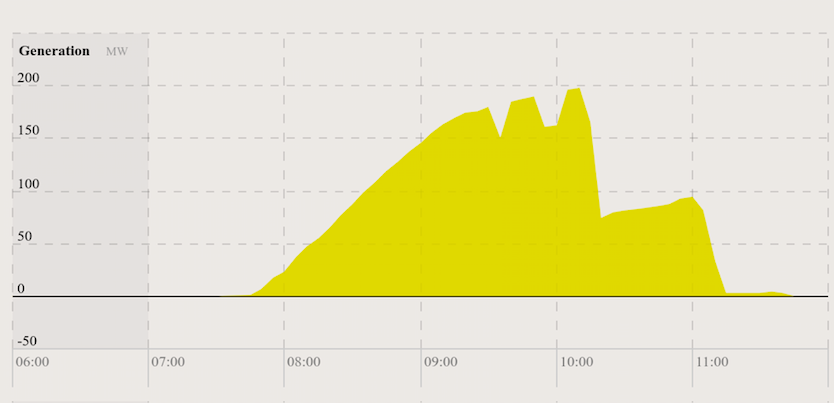
The two biggest solar farms in South Australia were switched off for long periods this week as wholesale market prices fell below zero – the result, apparently, of new “zero price clauses” in power purchase contracts.

As RenewEconomy reported on Tuesday, and updated on Wednesday, wholesale prices in South Australia fell below zero for extended periods on Tuesday (nearly six hours), and on Wednesday (nearly four hours).

This was the result of high wind and solar output, as well as relatively low demand, and export limits (down to 50MW) on the main link to Victoria because of maintenance works, which meant that excess renewable production could not be traded interstate.

As Dylan McConnell, from the Climate and Energy College in Melbourne, points out, and illustrates with the graph above from the OpenNem resource, the state’s two biggest solar farms both switched off power on Wednesday.

The Bungala One and the semi-complete Bungala 2 projects cut output from around 1030am, ahead of the anticipated zero pricing event, while the newly-complete Tailem Bend solar farm cut power off on both Tuesday and Wednesday from around 11am as the prices hit zero. Both projects were offline for nearly six hours on Wednesday.

Both the 220MW Bungala projects and the 95MW Tailem Bend projects have long term power purchase agreements with Orign Energy and Snowy Hydro respectively.

But a new feature of PPAs being signed in Australia these days is a “zero price” clause that means that the off-taker will not pay for the output of the solar farm at the contracted price if the market price falls into negative territory. This is considered a major risk in states like South Australia, and Queensland.

This is because the off-taker does not want to pay twice – once for the contracted price to the solar plant owner, and secondly the market price for the output. As a result, the solar farm is switched off.

In the case of Tailem Bend, that must have been frustrating because the solar farm only reached full commercial operations, and permission to operate at full capacity, on April 29, the day before the zero pricing events.

The first 110MW stage of the Bungala solar farm was completed last year, but the second 110MW stage has been working slowly through its permissions. It only reached its next stage of permissions, which allows output of around 30MW, in recent weeks, but also had to switch off when prices fell below zero and to lows of minus $120/MWh.

In any case, negative prices should not be a long term phenomenon, even if the growth of rooftop solar matches periods of minimum demand, an event that the market operator says could start to occur within a few years.

The addition of more battery storage and pumped hydro will be able to soak up the excess wind and solar output, and act as a “solar sponge”, even when the links to other states are constrained. Certainly, more solar farms will be looking for storage of one to two hours to soak up the output in such events. Being switched off is not part of the business model.

For the moment, installations like the Tesla big battery operated by Neoen at Hornsdale have been having a party this week, getting paid to top up when the prices go negative, and then selling into the grid when prices rise again. As some industry analysts have noted. this is a great opportunities for household solar and “visual power plants”, as well as charging electric vehicles.

Energy Stuff provides a full range of new smart solar systems which can include battery ready inverters or systems with integrated battery storage. All our systems come with smart energy management to provide real time monitoring and energy efficiencies. Finance options are available, simply ask our knowledgeable staff for details.

For further information call 1300 656 205 or go to our website at

https://ongrid.energystuff.com.au/new-solar-system/

The hidden culprits around the house sending your winter heating bills soaring

Written by Jenny Brown / Domain / 2 May 2019

Main image: Many houses are hiding ways that your send your bills skyrocketing. Photo: Leigh Henningham

Here they come again, those icy fingers of winter that – unless you’ve been a diligent eco-fundamentalist and very effectively insulated your house against heat-in and heat-out issues – you’re bound to feel sneaking in through any gap in your home’s thermal envelope.

You’ll feel it in the deep south, in the mountains, in the inland on those chilly and starry winter nights, and even in southern Queensland for those few cool weeks of July and August when a breezy Queenslander design works the wrong way. If you haven’t got a heater pumping, you’ll be dreaming of a log fire.

If you’re in a draught-porous house that, as energy efficiency consultant Richard Keech says, “acts like a leaky bucket”, you’ll also feel it in your hip pocket.

Sustainability Victoria says heat loss, which can affect a majority of houses, can push your winter energy bills up by 25 per cent.

And, it gets worse. For every degree you set your heating thermostat above 18-20 degrees, the energy costs rise by 10 per cent.


The cooler weather can have all us of pining for a log fire.

Yet, says Keech, who has conducted 500 energy efficiency assessments on Victorian homes in the past five years, the motivation for people to review their home’s “24/7 uncontrolled ventilation issues” – draughts – is motivated more by their comfort level than it is about reducing costs.

“They find they’re just not warm enough. And when people can’t stay warm or cool enough, it really focuses the mind,” he says.

There are the obvious heat leaks: draughts under doors and the poorly insulated walls, floors and ceilings. “I could go on forever,” says the engineer who has a masters degree in environmental energy efficiency.

But there can also be many unexpected holes in your home’s thermal envelope. Keech lists downlights, extractor fans, wide-mouth chimneys and poorly-sealed door frames and window architraves.

“Even in a well-insulated house the thermal performance will be dominated by the worst performing bit,” he says.

“(Older) downlights can be surprisingly problematic as they’re often designed to let air pass through them. They also leave a hole in the insulation. Some houses have dozens of these lights, and it’s like having a bloody big hole in the ceiling.”


Downlights can be troublesome for allowing draughts into your home. Photo: iStock

Keech says simply replacing bulbs is not recommended because although it does improve lighting efficiency, it’s a lost opportunity to improve other problems. “You need to replace the entire fitting with one of the new sealed LED fittings that are not that much more expensive.”

A similar cumulatively significant cause of heat loss can be all but invisible to the untrained eye. But when he sees a tell-tale line of dust along a window sill or door frame, “it’s a sign of a persistent draught”.

When Keech looks above a window or door jamb, which most home-owners would probably never consider inspecting, he often discovers gaps.

“Typically, they can be enough to put a credit card into. But some are big enough to put a finger into,” he says. “This is sloppy building work, and if they’re in all rooms, in aggregate, they can add up to metres of leaks. Architraves need to be properly sealed.”

Beneath a door, a permanently affixed draught stopper that can be as little as $7 at your local big box hardware outlet, or by adding a sticky strip around the whole door jamb, “are not the best ways to seal a door because they disregard the fact that most doors are warped, typically at the top and the bottom”.


Exhaust fans, when in not use, are also a big culprit. Photo: iStock

Exhaust fans that aren’t spinning can also “let air pass through easily, which is another big hole. You can either replace them or cover them with a backdraught protector”.

Old style chimneys that aren’t in operation are a huge problem but are another of what Keech calls “the low hanging fruit” of his “weak link analysis” of poorly-performing houses, because they too are generally affordable to seal up.
“We do that by carving a block of foam rubber that can be used to plug the chimney, but that is also removable.”

Counterintuitively, perhaps, the author of the chattily informative blog New Energy Thinking and a book, The Energy Freedom Home, Keech says it’s the vintage homes that may start with the worst problems but that have greater scope for improvement “because they were better built”.

“A lot of newer homes have problems that are harder to fix because they have more downlights and often have no eaves.”

Energy Stuff provides a full range of new smart solar systems which can include battery ready inverters or systems with integrated battery storage. All our systems come with smart energy management to provide real time monitoring and energy efficiencies. Finance options are available, simply ask our knowledgeable staff for details.

For further information call 1300 656 205 or go to our website at

https://ongrid.energystuff.com.au/new-solar-system/

Rushed Queensland solar rules to drive up costs: CEC

2nd May 2019 / EcoGeneration

New rules rushed through by the Queensland Government are likely to hit the commercial solar sector hard when they come into effect in less than two weeks, and will make it harder for the state to meet its own renewable energy target, the Clean Energy Council said today.

Anna Freeman, the Clean Energy Council’s director of energy generation, said the new regulations for solar meant that electricians had to be used for work such as carrying unplugged solar panels or bolting them to a rail.

“This is like having to call in an electrician to hang a TV on a bracket on your wall. It’s absurd. It would be virtually impossible to electrocute yourself by handling an unconnected panel. You’re at greater risk from plugging in a toaster at home,” Freeman said.

“The changes will drive up the cost of building both large solar farms and commercial solar systems installed in places like shopping centres, schools, swimming pools and factories.

“Estimates from solar businesses are that the cost of building commercial projects will increase by 10-20%, delaying the payback period for businesses and schools and making many projects unviable.

“Combined with the effect on large-scale solar farms, these changes will slow the installation of solar across the state and make it more costly for businesses to control their energy costs.

“Not even an electrical apprentice will be able to handle and attach an unconnected solar panel, so the opportunities for apprentices to work in the new solar industry are going to be slashed. At the very time in which the Federal Labor Party announces its commitment to boost apprenticeships in renewable energy, the Queensland Government continues to persist with a regulation that will kill off many clean energy apprenticeships.

“From 13 May, those businesses which already have projects under construction are going to have to wear this extra cost, without the ability to pass this on to their customers. This means many small- to medium-sized businesses will be out of pocket,” she said.

Freeman said the sudden regulatory change had not been justified, with the government not able to demonstrate a single safety incident on a solar farm relating to the mounting and fixing of solar panels.

“To our knowledge, no other jurisdiction on the planet has such extreme and unnecessary regulation in place,” she said.

“We are asking the government to immediately delay this new regulation before people start losing their jobs, so that proper consultation can take place with the solar industry.

“If the Palaszczuk Government is willing to return to the table, we are confident that we can work co-operatively together with all parties to find a way forward that does not destroy jobs and investment.”

Energy Stuff specialises in Residential Solar with emphasis on Repairs, Replacements and upgrades. We also provide new systems, battery storage, Small Commercial, Off-Grid systems and smart monitoring systems. Energy Stuff only uses CEC accredited installers and we fully comply with the Victorian Govt. Solar Rebate Program.

For further information please call us on 1300 656 205 or go to our website at http://www.energystuff.com.au

Should I go Off the Grid?

  • Off-Grid Power is cheaper than you think – Today it’s financially viable.
  • Technology improvements mean living off-grid, like the way you currently do connect to the network – has never been easier!
  • Today no limitations – you can have A/C, Pool, Electric cooking, even underfloor heating.

The upfront cost of installing an Off-Grid system is an investment you make to own your electricity production, end of electricity bills, shrinking your environmental footprint, having energy independence and not being exposed to the sort of price shocks and reliability issues that you can’t control when you are connected to the grid.

SHOULD I GO OFF-GRID OR GET GRID CONNECTION?

With rising electricity prices and enormous upfront connection costs, choosing to go Off-Grid for your electricity is increasingly more attractive. When choosing between an Off-Grid system or paying to connect your property to the grid, looking at your systems life cycle will help to understand the total cost of each option over the long term, not just the initial upfront cost.

The biggest mistake people make is purchasing a system that is too small to power their lifestyle. Going Off-Grid with the dream of never paying a power bill again can be extremely attractive. However, if you can’t afford to do it properly, you’ll end up wishing you got connected to the primary electricity grid.

Before you start your journey towards Off-Grid living, there are a few things to consider:
• Firstly, find out what the cost would be to get a grid connection. As well as the initial connection cost, there is the projected cost of total power over the next 10-15 years plus an expected 5% price increase per year
• Get an energy assessment done to find out what kind of Off-Grid system is best suited to your circumstances, expectations and budget. Get in touch with us, and we’ll give you a free energy assessment, design a customised Off-Grid system and guide you through the process with our best recommendations.
• Find the right balance between value for money and quality. Buying the cheapest Solar PV System on the market is a calculated risk when it comes to solar systems that are connected to the conventional grid. If your inverter fails, your solar system may not work, but at least you will still have electricity in your home. WHEN YOU ARE OFF-GRID, POOR QUALITY COMPONENT FAILURES WILL LEAVE YOU WITHOUT POWER. IT IS NOT WORTH THE RISK!
• If you want the best value for money, use standard business sense. The saying “You get what you pay for” is generally true! Try and future proof your system by being realistic with your projected energy use and balancing this against your budget.

THE MANY REASON FOR GETTING AN OFF-GRID SYSTEM
• You are building a new shed or workshop on an existing rural property
• You are looking to create a new home in an area with no grid connection
• You are looking for the perfect green-field solution for your holiday retreat/weekender without the ongoing commitment and cost of grid connection
• You have a small remote shed or shack that you need power for
• You are looking for sustainable living
• The cost of connecting to the grid is higher than installing an independent Off-Grid system

WHAT YOU CAN EXPECT WITH OFF-GRID POWER
• No ongoing power bills
• No connection fees
• Protection from rising power prices
• Independent and sustainable electricity
• The equipment you pay for, your own
• A Green and Renewable source of electricity

WHAT IS DIFFERENT BETWEEN LIVING OFF THE GRID AND LIVING ON THE GRID?

If your system is designed correctly, the difference is very little, as even in bad weather, such as prolonged rainy days, a back-up generator with auto start function will ensure your home always has the power it needs.

WHAT TO CONSIDER WHEN MAKING THE MOVE TO OFF-GRID POWER

Going Off-Grid will require you, and your family, to become a lot more conscious of your energy usage, as you don’t have the support of the grid.
You must consider five important things and how they relate to your systems’ requirements, possibly saving you thousands of dollars in system costs. Energy-intensive appliances are those that heat or cool a space, be it air, water or an element. The major considerations are:

  1. Gas or Solar Hot water – An average hot water system for a 3 or 4-person house may easily consume 4 kWh per day alone. Gas or Solar Hot water is a great option to drastically reduce your power consumption, in-return saving you big money. Important to note that in bad weather you may need to boost your solar hot water system and if it has an electric boost, you’ll end up using a lot more power at a time when the generated power from your solar panels is drastically reduced.
  2. Gas Cooking – Electric cooktops and ovens are another significant requirements for your Off-Grid system. Although running ovens and electric elements from your Off-Grid system are achievable you may find going with gas will save you money.
  3. Wood fire heating – Electric Bar heaters are massive consumers and when run for long periods don’t fit in well when living Off-Grid. Wood fire heating is an option taken up by many of our customers. A wood fire stove is a great way to heat your living spaces.
  4. Efficient appliances – If you are buying a new property, you can take the opportunity to ensure you get the most suitable home appliances, thereby reducing your Off-Grid system’s requirements. Energy star ratings are now present on all appliances, along with a yearly kWh usage. This can be used to select the most efficient appliances for your budget. The LED lighting is a very economical option and gives off good light. As many lights are usually on for at least a few hours a day, a more efficient light can add up to significant savings.
  5. Change your routines – It’s simple. When the sun is out, use your most significant energy consuming appliances. We call it “Blue Sky Rule”. Do your washing, vacuuming and all other household routines during the day, this way the electricity is in effect supplied directly from your panels and not discharging from your battery storage. For smaller systems, you may want to load-share, which means you stagger the use of your high draw appliances such as toasters, microwaves and kettles etc. This will reduce the requirement for a large Off-Grid inverter which will save you even more money on the system cost. Use common sense and follow the “Blue Sky Rule”.

We offer Australia comprehensive Off-Grid systems from BlackMax DIY kit system up to large customised, fully installed Off-Grid systems for residential and small businesses across Australia.

The BlackMax DIY Kit system is the ideal solution if you want to power an outlying area that has no grid-connected power. It’s designed for applications with a daily power usage from 2 up to 10kWh plus during the daytime, the excess generated energy from the chosen solar PV array. We’ve done all the hardware, cabling, mounting equipment for metal roof and all electronics, i.e. inverter and battery bank are all included saving the client precious time. The BlackMax plug and play Shed Power System, 48V can be installed by any competent person, without the need for an electrician or solar installer.

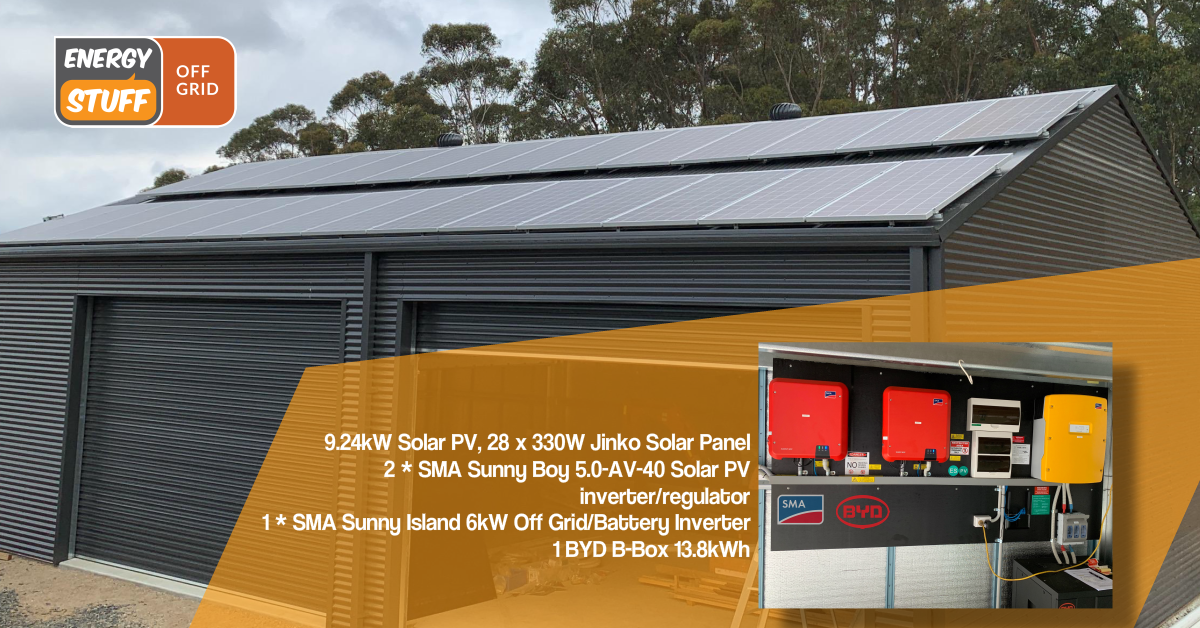
Customised Off-Grid systems are based on an energy assessment and designed around expected energy usage per day. They are built with the latest proven technology that’ll be the future living Off the Grid. The solar PV array is the primary power source for the living, the battery bank the second and a back-up generator the third power source. With the capacity of the SMA inverters, you can during daytime live a normal life like you are connected to the grid. You don’t have to stress about what you can or can’t use simultaneously, but it’s recommended to use common sense and don’t start up all appliances simultaneously and do the regular household routines during daytime when power is still generated from the solar panels.

ABOUT ENERGY STUFF

Energy Stuff is Australian owned and with proven national supply and service partners across the country. Energy Stuff was launched in late 2015 and is focused on supporting the Australian residential solar market with a full range of solar systems, solar upgrades, replacement units, smart monitoring systems, Off-Grid solar systems, and battery storage capability. Energy Stuff offers clients a secure and cost-effective energy future -with a comprehensive range of new smart energy solar systems, expert servicing & repairs, and Off-Grid solar installations.

AUSTRALIA WIDE SERVICE

Our Off-Grid team have decades of expertise in providing Off-Grid solar systems and Off-Grid battery storage Australia wide. Our solar and battery storage systems are custom designed and installed for each client’s situation and location, no matter where they live in Australia, we can provide the best solar battery storage and off-grid energy solutions, helping them genuinely get off the grid. Off-Grid Energy Stuff works with CEC Accredited Off-Grid installers across Australia for all of our installations. By using local installers, we can also provide ongoing service and backup to ensure your system is maintained and quickly put back into service if you ever have a fault.

CUSTOMER FEEDBACK.

After googling and speaking with a lot of solar companies to design and supply enough power to run our household (which consumes quite a bit of electricity with teenagers) the return quotes were immensely different in cost and also when the power could be supplied. Energy Stuff Off-Grid was $7000 cheaper to the nearest quote so we spoke with Scott who ensured us we had come to the right place and we had. Our house was fully powered in just over a month and we have enough electricity to go stupid with. (No more turning off power points and light switches to save on bills). Scott was with us all the way and still is to this day. Very knowledgeable guy and made our transition from electricity companies to solar so stress free and simple. We had nearly been ripped off from one company that didn’t want to return our deposit- even though they had a 30-day cooling off period. We put our trust in Energy Stuff Off-Grid and they totally delivered. We are so impressed with them, we have offered to allow people to view our setup that are considering off grid solar, through contact with Energy Stuff Off-Grid. So so happy we found a company who aren’t there just to take our hard-earned money. Rare these days.

Many thanks guys, we can’t say enough. 🙏

Scott and Michelle”

Energy Stuff specialises in Residential Solar with emphasis on Repairs, Replacements and upgrades. We also provide new systems, battery storage, Small Commercial, Off-Grid systems and smart monitoring systems. Energy Stuff only uses CEC accredited installers and we fully comply with the Victorian Govt. Solar Rebate Program.

For further information please call us on 1300 656 205 or go to our website at http://www.energystuff.com.au